Four sub-Earth planets orbiting Barnard’s Star from MAROON-X and ESPRESSO
Mar 11, 2025·,,,,,,,,, ,·
0 min read
,·
0 min read
Ritvik Basant
Rafael Luque
Jacob L. Bean
Andreas Seifahrt
Madison Brady
Lily L. Zhao
Nina Brown
Tanya Das
Julian Sturmer
David Kasper
Rohan Gupta
Gumundur Stefansson
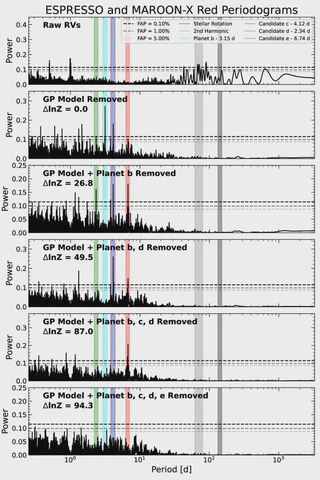
This plot shows the computed GLS periodograms for the combined residuals of MAROON-X Red channel and ESPRESSO radial velocities. A beta distribution for the planetary eccentricities has been used for all planets.
Abstract
Barnard’s Star is an old, single M dwarf star that comprises the second-closest extrasolar system. It has a long history of claimed planet detections from both radial velocities and astrometry. However, none of these claimed detections have so far withstood further scrutiny. Continuing this story, extreme precision radial velocity measurements from the ESPRESSO instrument have recently been used to identify four new sub-Earth-mass planet candidates around Barnard’s Star. We present here 112 radial velocities of Barnard’s Star from the MAROON-X instrument that were obtained independently to search for planets around this compelling object. The data have a typical precision of 30 cm s−1 and are contemporaneous with the published ESPRESSO measurements (2021–2023). The MAROON-X data on their own confirm planet b (P = 3.154 days) and planet candidates c and d (P = 4.124 and 2.340 days, respectively). Furthermore, adding the MAROON-X data to the ESPRESSO data strengthens the evidence for planet candidate e (P = 6.739 days), thus leading to its confirmation. The signals from all four planets are −1, the minimum masses of the planets range from 0.19 to 0.34 M ⊕, and the system is among the most compact known among late M dwarfs hosting low-mass planets. The current data rule out planets with masses >0.57 M ⊕ (with a 99% detection probability) in Barnard’s Star’s habitable zone (P = 10–42 days).
Status
Published in Astrophysical Journal Letters
Publication
The Astrophysical Journal Letters, 982(1)