PULSE-A Mission Overview: Optical Communications for Undergraduate Students
Jul 8, 2025·,,,,, ,,,,,,,,,,·
0 min read
,,,,,,,,,,·
0 min read
Logan Hanssler
Seth Knights
Graydon Schulze-Kalt
Juan Ignacio Prieto Asbun
Robert Pitu
Lauren Ayala
Rohan Gupta
Vincent Redwine
Spencer Shelton
Catherine Todd
Maya McDaniel
Sofia Mansilla
John Baird
Mason McCormack
Leah Vashevko
Tian Zhong
Michael Lembeck
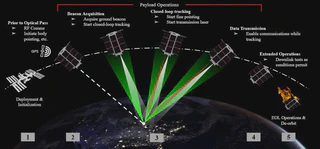
Concept of Operations Visualization
Abstract
Recent advances in the size, weight, and power (SWaP) requirements for space-based sensing have dramatically increased the demand for high-bandwidth downlink. However, high data rate RF transceivers still pose significant SWaP and cost restrictions, especially for university-class CubeSat missions. Optical communication may provide a solution to this challenge, enabling data transmission with order-of-magnitude rate increases over RF while being both secure and SWaP-efficient. The Polarization-modUlated Laser Satellite Experiment (PULSE-A) is a University of Chicago mission to demonstrate optical downlink at a data rate of up to 10 Mbps using circular polarization shift keying (CPolSK). PULSE-A comprises a <1.5U Optical Transmission Terminal, 3U CubeSat Bus, Optical Ground Station (OGS) employing an amateur telescope, and RF Ground Station (RFGS), all of which are being designed and integrated by a team of over 60 undergraduate students. The mission objective is threefold: (1) to provide hands-on educational experiences for undergraduate students, (2) to make hardware for optical communication systems more accessible via open-source design, and (3) to explore the viability and potential advantages of using CPolSK for optical downlink. In this work, we present an overview of the mission, and we describe the PULSE-A Team’s learning-oriented approach to program management and engineering. We especially emphasize the importance of student leadership in PULSE-A’s development process and the resulting benefits for the University of Chicago community. We also highlight takeaways from the experience of founding and operating an undergraduate student-led CubeSat program.
Publication
SmallSat Conference 2025